08/10/2026
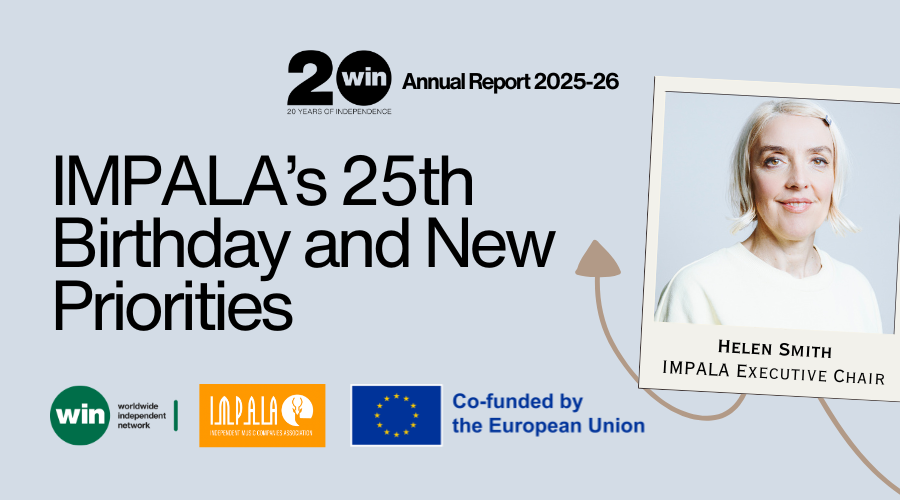
This interview with IMPALA’s Executive Chair Helen Smith, which was featured in the WIN Annual Report 2025-26, highlights the key aspects of WIN’s collaboration with its European member IMPALA as part of its EU-funded network programme.
Independence means different things to different people. What does it mean to you in 2026, and why does it matter?
Freedom to decide what’s in the best interests of your artists. Only businesses which are independently owned have this, and it is more important in 2026 than ever – an opportunity and a responsibility. Our interview series “Faces of the Independent Sector” which we are running for our 25th birthday is a great illustration of what this freedom means.
IMPALA has just turned 25 and is celebrating this year with different projects under the theme #WhyIndependentsMatter. What are IMPALA’s priorities?
Everything revolves around making the business case for the independent sector. It’s great that WIN has translated the executive summary of Dan Fowler’s report underlying the importance of the sector and how independence is synonymous with diversity. Functioning of the digital music market is also a key priority as set out in IMPALA’s new plan. This includes improving the remuneration and discoverability of independent music and building a new provenance labelling system, as well as the opportunities and challenges of AI, tackling fraud, and also integrating sustainability aspects into this equation.
IMPALA makes practical tools available for independents in areas such as sustainability and equity, diversity, and inclusion. How important is this work to IMPALA?
IMPALA members decided years ago that they wanted to lead change across the board and that includes these areas of action as well as digital. The Carbon Calculator is really interesting, because it was crowdfunded in less than six weeks as the first (as far as we know, still the only) bespoke tool covering label functions and fully compliant with worldwide reporting standards (GHG protocol, scopes 1, 2 & 3) from the start. Merlin also supports the tool through the Weidenmüller Sustainability Fund. On equity diversity and inclusion, we launched a new toolkit for businesses of all shapes and sizes to track their performance. The developers say it is the first sector initiative of its kind they have seen.
Finance is another area IMPALA is working on. What’s in the pipeline?
We are working with Emmanuel Legrand on a set of recommendations that are going to be very practical and business focused. Independent artists need structures that are strong, stable, and financially robust, with the freedom to retain independent ownership if they wish. And that’s what we want this finance work to help achieve.
IMPALA is an early example of how regional collaboration can be effective. How do you see this evolve within a global network?
IMPALA’s founders realised the potential of collective intelligence early on, and our focus has always been very bottom up, welcoming different business models, brands, and identities within the network. I think that’s one of the main reasons IMPALA has been effective. Collaboration with other parts of the ecosystem, including majors, artists, performers, authors and publishers, managers as well as live and beyond, is also a hallmark of IMPALA’s work, and it’s super important. WIN’s work is essential because all of our opportunities and challenges have local, regional, and international aspects that are all moving parts. The role of WIN is also recognised by IMPALA’s EU network programme, which underlines the importance of promoting connections and sharing knowledge between different regions of the world.
We are proud that IMPALA can contribute to WIN’s work financially in this way, on top of its membership fees. WIN has done an amazing job in terms of network development, and all the work building new regional structures has already paid off. This is crucial in making the sector stronger in the long term.

This interview with IMPALA’s Executive Chair Helen Smith, which was featured in More
This interview with A2IM’s CEO Ian Harrison was originally featured in the More
Marauder creates impactful marketing and development programs that directly benefit music communities. More